
1905
Josef Sakař (1856–1936) was an architect who worked primarily in Prague’s Karlín district. He also served as a building councilor and a member of the Czech Academy of Sciences and Arts. During his youth, while spending extended periods in Rome and Florence, he devoted himself to the study of antiquity and the Renaissance. As an architect focused on historic preservation, he devoted himself to renovations and alterations; for example, he rebuilt the Krížovníků Palace and the Provincial Bank, among others. He advocated for historical accuracy and for preserving the period spirit of historic buildings, even in newly added decorative details. His final work was the Faculty of Philosophy at Charles University.
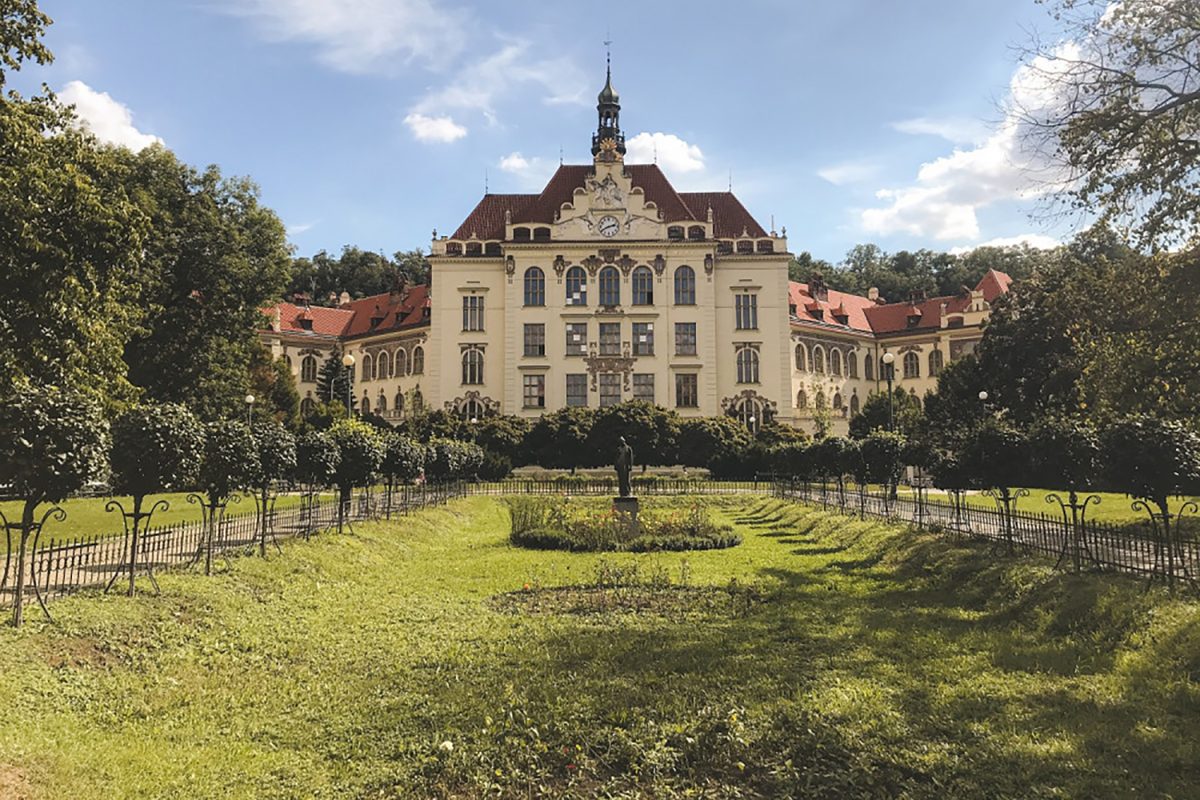
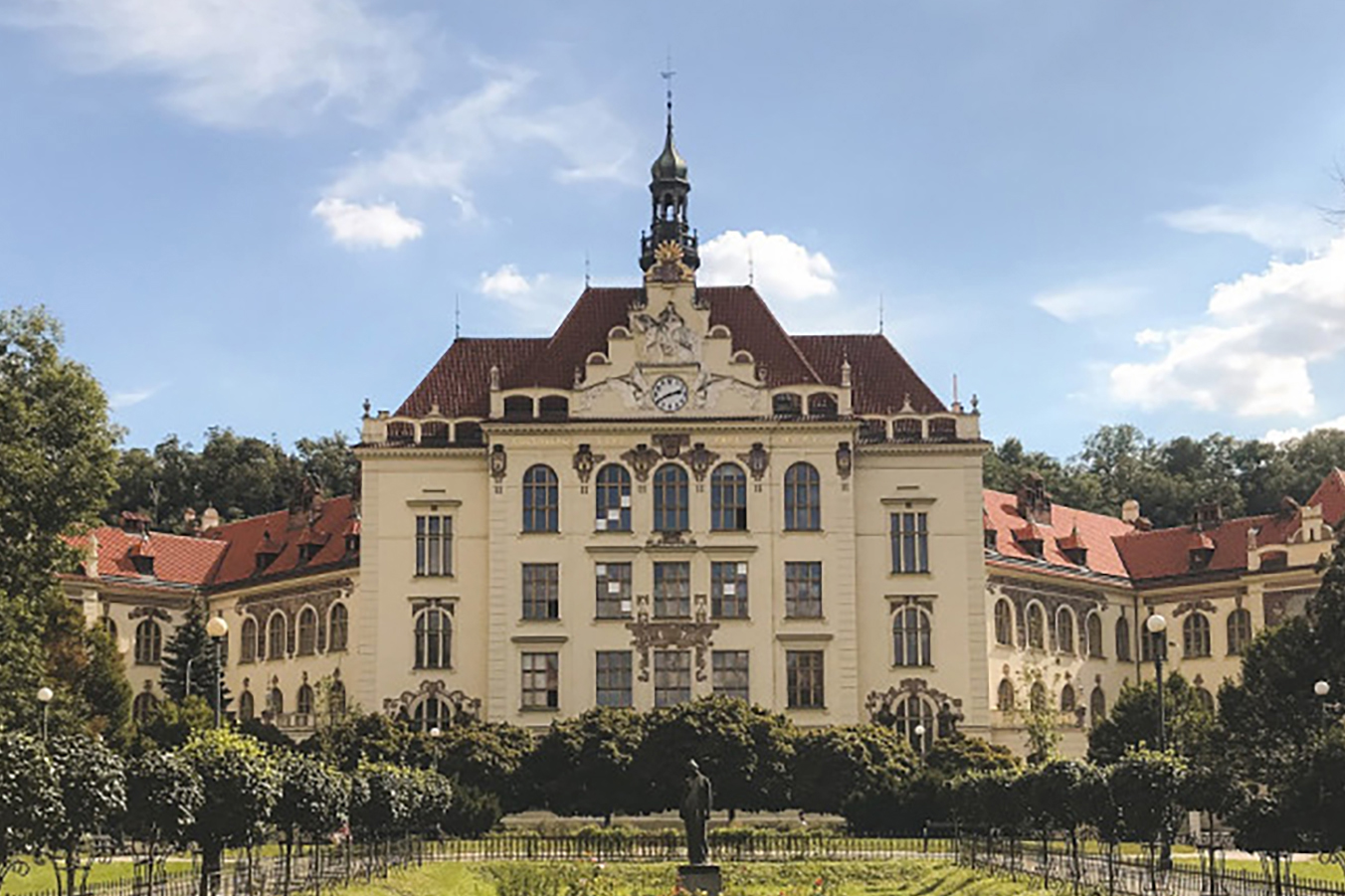
The Sakař School was built between 1904 and 1906 in the Neo-Renaissance style. The building, which is two stories tall on the sides and three stories tall in the central section—with a layout reminiscent of a palace—is richly decorated with sculptures and paintings. It was constructed according to plans by Josef Sakař and funded by the political and school community of Karlín. The work was supervised by Matěj Blecha. In total, this new school comprised 21 classrooms, which housed both elementary and secondary schools, classes for girls and boys, and even a kindergarten; it also featured a gymnasium, complemented by outdoor courtyards and playgrounds. The majestic school thus became a natural landmark of what was then Riegrovo Square (now Lyčkovo Square).
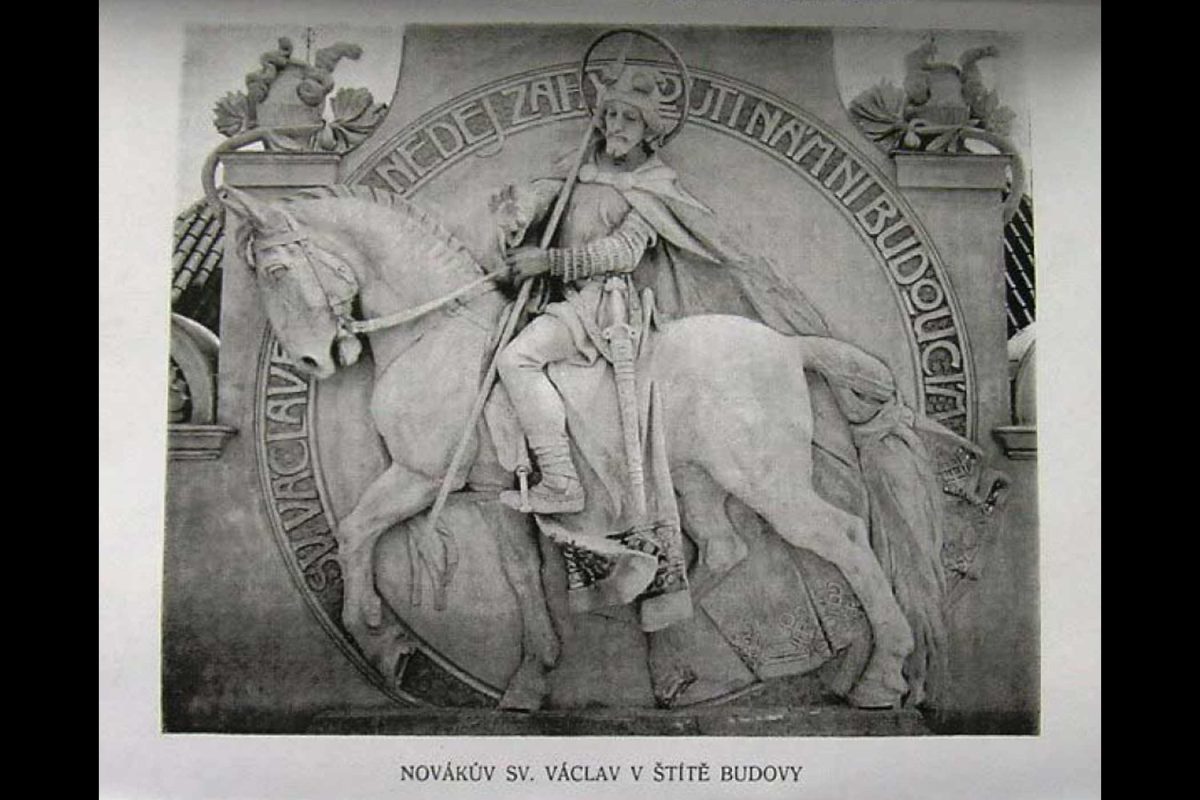
The most notable work by Novák is the equestrian statue of St. Wenceslas in the main gable itself. The dynamically rendered and deeply three-dimensional figure of the saint leans forward from his horse’s saddle and gazes down upon the square. The horse is in mid-stride; the rider leans into the stirrups, and his long cloak billows as if in the wind along its entire length, from the saint’s shoulders all the way to the horse’s hooves; the entire group thus appears very lifelike. Novák succeeded in combining the dignity of the Czech patron saint with the warmth with which he bends down from the heights of his position toward his people. A sort of halo for the scene is formed by a circular, Art Nouveau-style inscription reading “Saint Wenceslas, do not let us or our descendants perish.” The sculpture also included gilded metal elements: an iron cross and a brass halo. Beneath the shield is a large stucco relief depicting an allegory of knowledge through the motif of a winged hourglass, framed by apple tree branches. It is possible that Novák may also have contributed to other stucco decorations on the school’s facade. Since the range of ages and educational levels among the institute’s students was considerable, the stucco work features iconographically quite original motifs, combining fairy-tale imagination with didactic symbolism. Here we find a frog queen in the reeds, a hare with a sheaf of wheat, a globe with laurel leaves, a grasshopper in friendly conversation with an ant, Jan Amos Comenius with two little angels and botanical decoration, as well as a book framed by foliage, flanked on either side by owls, a sitting cat, and a composition made up of tennis rackets.
The sculptures above the portals and the relief of J. A. Comenius were created by the sculptors Štrunc and Mára; the other sculptures were crafted by the stucco artists Kuneš and Rákosník. The facade is also extensively covered with sgraffito measuring 7 x 7 m, depicting historical events that took place in the Karlín area: Jan Žižka’s reconciliation with the people of Prague at Špitálské Pole in 1424, and the coronation of King Ferdinand at the Invalidovna in 1863. Furthermore, the scenes of school life between the windows continue the didactic theme of the decoration, adapted to children’s perception: “School is a sweet second mother,” “Every beginning is difficult,” “A healthy body, a healthy mind,” “Know and love your homeland,” “Knowledge is the greatest treasure,” and “Use what you learn for good.” All scenes are framed by sgraffito floral ornamentation and inscriptions; the same is true of the side walls of the main facade. In the gables of the side wings, we find oval medallions (presumably depicting Cyril and Methodius).