“ČIKLOVKA,” a satellite puppet film studio on Čiklova Street
1958–1989
“Art is good when it speaks to everyone. The only thing that matters is what the artist is saying—the content. So it’s about ideas, and those aren’t just Czech; they’re always simply human.”
Jiří Trnka
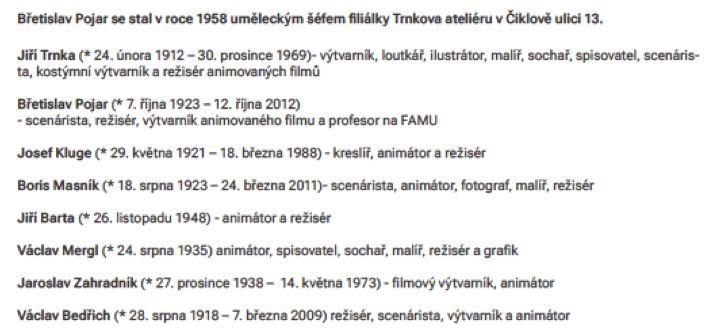
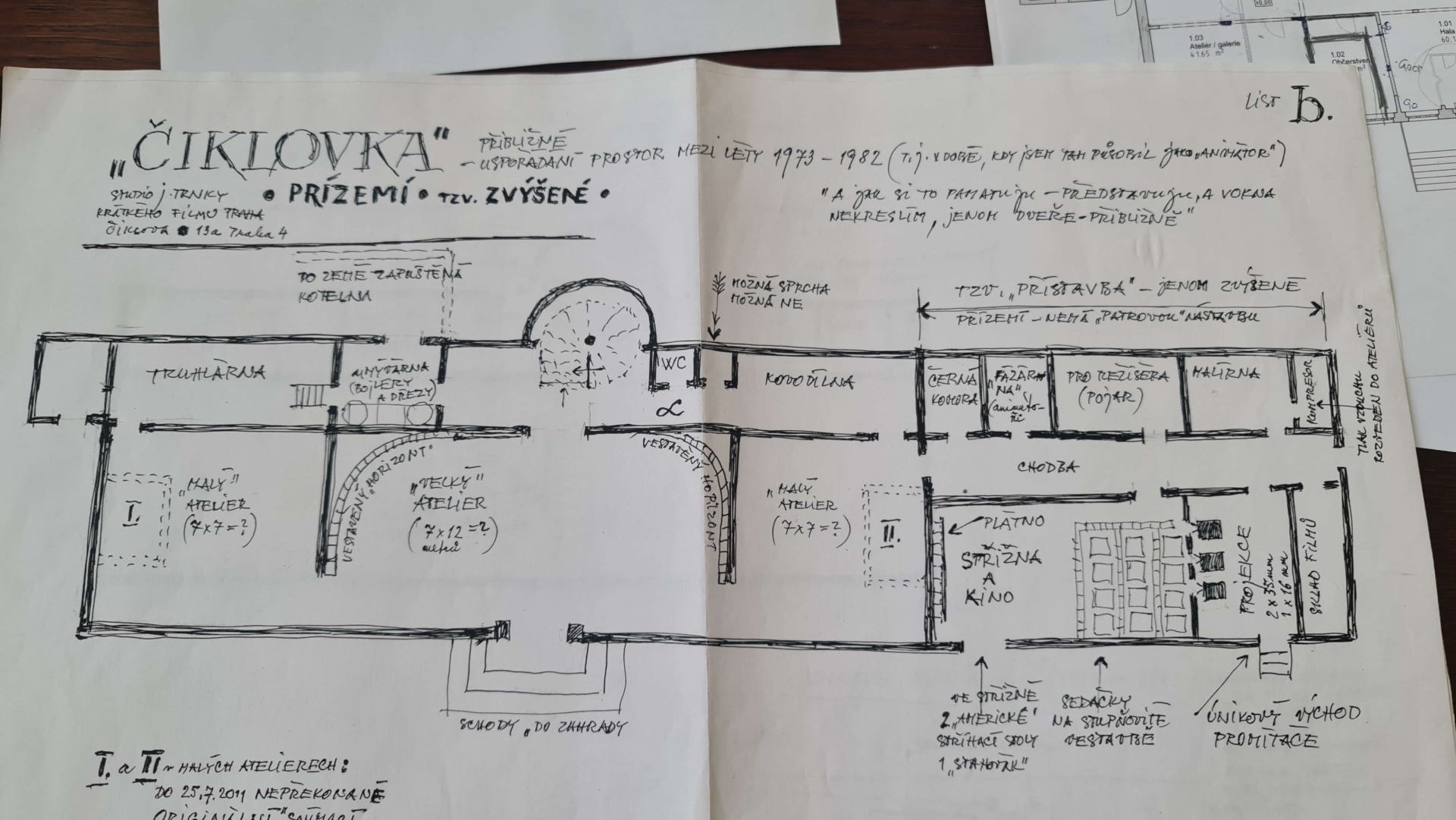
The artistic genius loci of Karel Novák’s stone sculpture workshop in Nuselské údolí did not disappear even after it ceased operations. After several years of neglect, in the spring of 1958—following necessary structural renovations—the former sculpture workshop came back to life with a creative spirit and artistic production, though this time in the form of film. For a full thirty years, until the end of 1989, one of the departments of the state-owned enterprise Krátký film found a home on its premises. This came about thanks to the sculptor Karel Novák’s son, who worked as a driver at Krátký film and brought the possibility of using his father’s studio to the attention of filmmakers seeking a new venue for their work. The former studio provided additional workspace where a newly formed team of film artists and animators, under the direction of Břetislav Pojar and Josef Kluge, created works that brought fame to Czech puppet animation around the world.
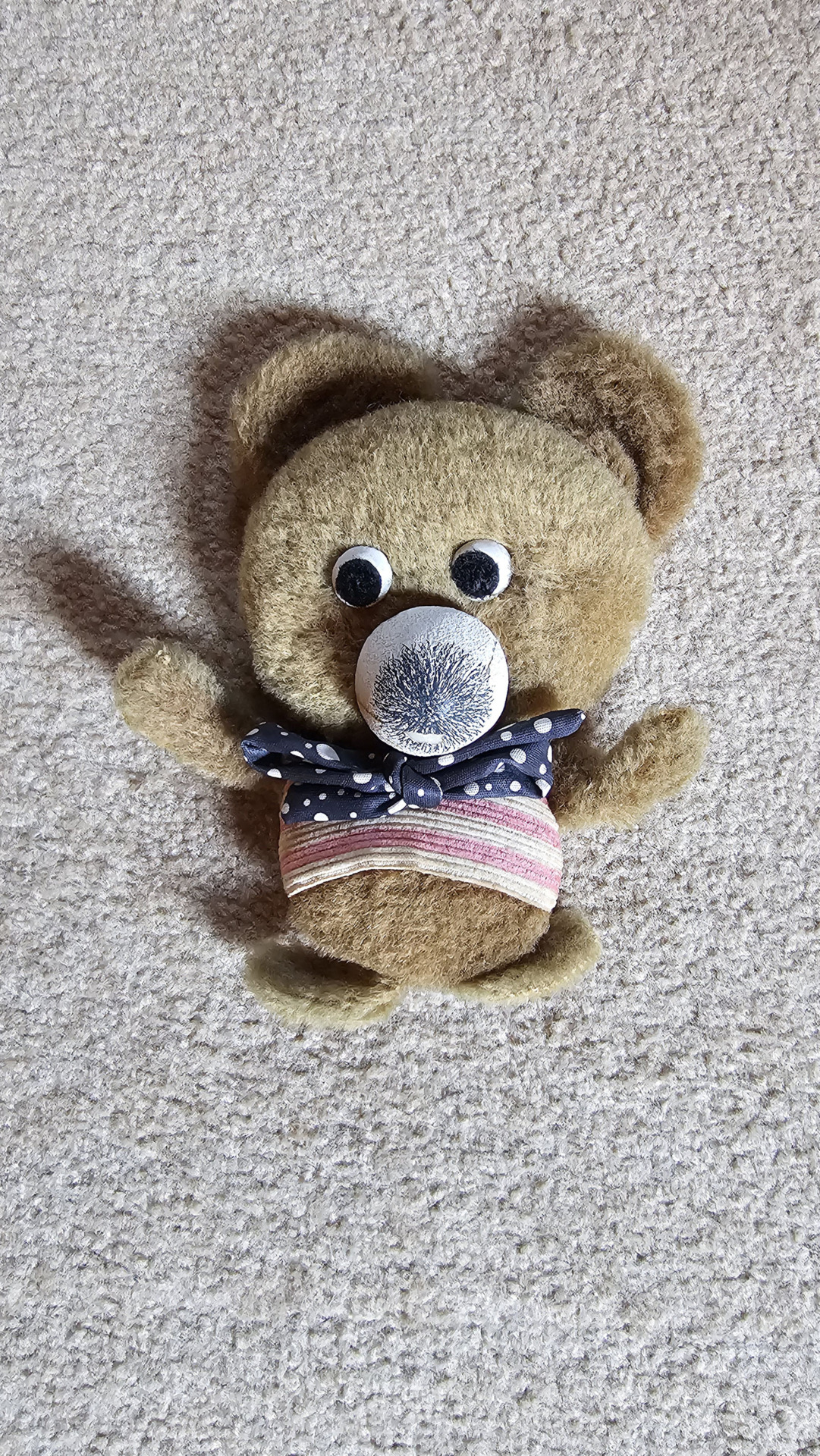
The first animation sequences for “Čiklovka” were created by animators B. Masník, P. Procházka, and S. Neumannová (later Procházková) in the spring of 1958. The project was directed by Josef Kluge. The film *Magical Skis* (1959) thus kicked off a thirty-year-long, magical era in the romantic garden below Vyšehrad, filled with the fantasy of animated magic. Břetislav Pojar filmed *The Lion and the Song* (1959) in Nusle with a new team and art director Zdeněk Seydl, and the film immediately began racking up festival awards. The 1960s went down in Czechoslovak film history in golden letters. During this period, the studio gave birth to a phenomenon in Czech animation production: the semi-plastic puppet technique, which, while maintaining the appearance of three-dimensionality, allows the puppets unlimited freedom of movement. This technique was fully utilized in one of the most famous animated miniseries, the stories of two bear brothers from Kolín, *Come On, Sir, Let’s Play* (1965–67). Other directors were given the opportunity to create their own works. These included Václav Mergl with his *Laokoon* (1970), and Jaroslav Zahradník with his plasticine film *Hliňák* (1972), which was followed by two loose sequels.
Starting in 1969, “Čiklovka” was filled with drawings by Josef Lada—J. Kluge brings the cat Mikeš to life. The famous “Bears from Kolín” series continued with additional installments (1970–73), and following K. J. Erben’s fairy tale *The Apple Tree Maiden* (1973), Břetislav Pojar paid tribute to Jiří Trnka with an adaptation of his book *The Garden* (1974–77). Under the supervision of Václav Bedřich, another of the numerous bedtime stories was created—*Mr. Krbec’s Little Animals* (1977–80) and Pojar’s *Dášeňka, or The Life of a Puppy* (1977–79). One of the last films shot in Nusle was Josef Kluge’s cut-out animation based on K. Čapek’s *The Gardener’s Year* (1987). Unfortunately, Kluge passed away on March 18, 1988, and so his next planned Ladov-style film remained unfinished. Shortly thereafter, the last employees left the studio under the pretext of necessary electrical repairs, and the garden and studios were abandoned. “Čiklovka” saw a brief resurgence in early 1989, when several scenes for Mr. Pojar’s new feature film *Motýlí čas* (1990) were shot there. After the 1989 revolution, the garden was left entirely at the mercy of vandals and the elements.
While the complex was operated by the state-owned enterprise Krátký film, the garden area was used very little. According to eyewitness accounts, immediately after the state-owned enterprise took over the complex, various organizations and private individuals began moving the exhibited sculptures off the premises, with the studio’s users unable to prevent this in any way. For example, the statue of Radegast by Albín Polášek was moved to the Prague Zoo, and many other sculptures began to adorn villas throughout Prague and the surrounding area. In the end, however, this actually proved beneficial for the preservation of the sculptures located in the garden. Far worse were the raids by vandals who destroyed both the garden structures and the garden itself—flowers, shrubs, and trees. In the memories of eyewitnesses, shared with us personally, pleasant recollections remain—whether of cherry festivals or romantic encounters in the deserted, romantic garden.
However, the garden portion of the complex suffered complete degradation only during the construction of the Nusle Bridge, when the entire garden became a construction site for the state-run Road and Railway Construction Company in Prague. The garden area was leveled by bulldozers, and the concrete elements of the garden architecture and the remains of the sculptures were used as reinforcement for the bridge’s concrete foundations. This also resulted in the removal of the only access road to the complex from Křesomyslova Street. The entire area of the cleared gardens was fenced off, denying access to users of the Short Film Center. A new temporary access road was established directly from Čiklova Street for the newly fenced-off and rebuilt studios, including the annex. Rubble from the demolished apartment buildings in the vicinity destroyed the last courtyard structures—workshops and storage sheds containing the final remnants of the stored sculptures. These were rediscovered 30 years later, but that’s a story for another time.
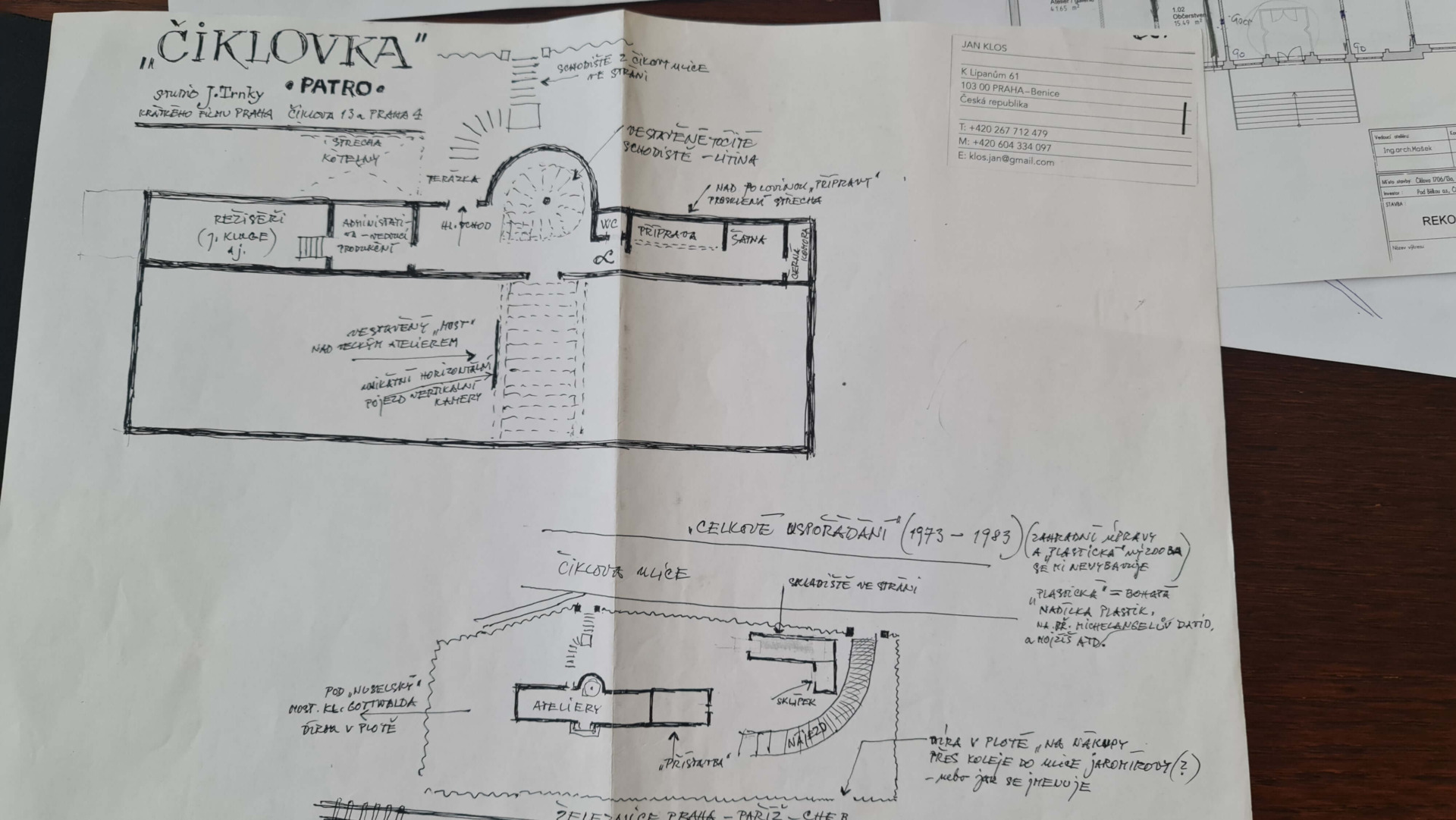
Much of what we know about this period was shared with us directly by the participants and staff of Krátký film during our joint meetings in the restored studios between 2000 and 2008. Those unforgettable encounters and the memories evoked by the stories of Prof. Břetislav Pojar, Jan Klos, Mrs. Procházková, and twenty other professional colleagues were an amazing experience. The handwritten documentation compiled by Mr. Klos detailing the studios’ use for the purposes of Krátký film is stored in our archive.