
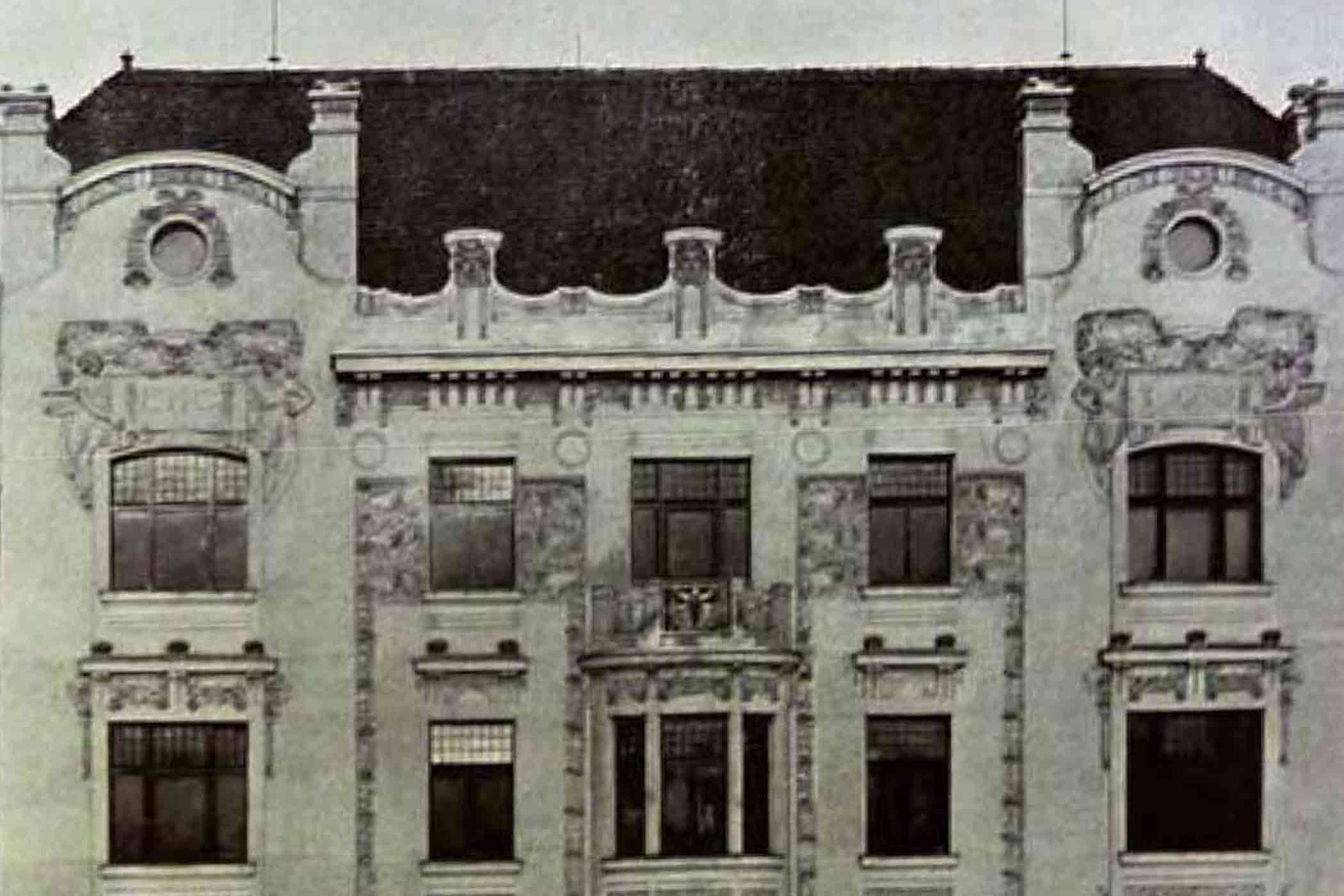
1903
The home of the successful industrialist Graba was divided into two sections: a four-story residential section and a two-story office section. The apartments had an average of seven rooms, and from the very beginning, the building was equipped with central heating, hot and cold water, and an electric elevator. It was, therefore, a luxury residence.
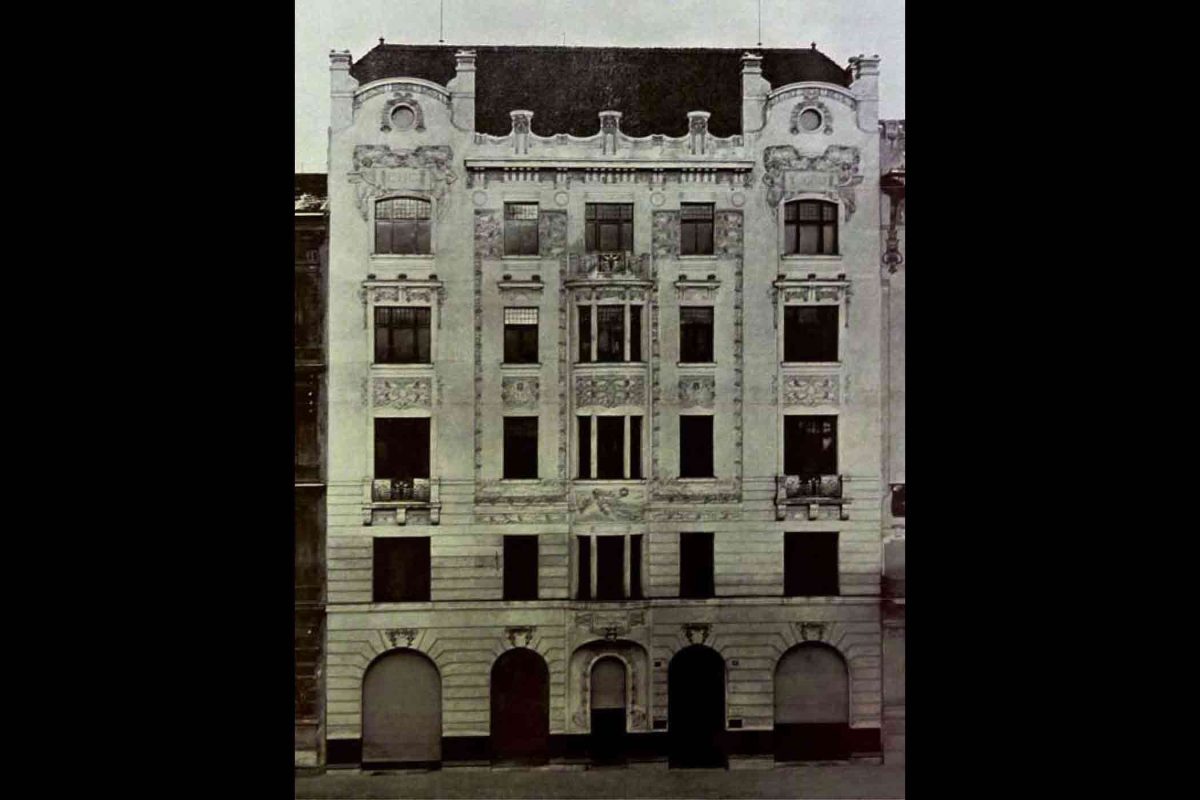
The facade of the house is very richly decorated; Novák worked on it based on designs by C. Klouček and Matěj Blecha. The building is divided into five vertical window axes, with the central section consisting of a semicircular projection. Prominent among the stucco decorations are the figural groups on the outer gables. These consist of two female figures against a background of plant motifs. The women, with billowing drapery hold between them a rectangular inscription shield bearing the owners’ monograms: E.H.G. Upon closer inspection of both figures, we see that they depict specific individuals, most likely Mrs. Grabová and her daughter. The daughter appears very young, as evidenced by by her shorter haircut. She is dressed in a very light, girlish dress. Mrs. Grabová, on the other hand, depicted more matter-of-factly in a kitchen apron with rolled-up sleeves. Her posture, with hand on her hip comes across as very resolute, a impression matched by the somewhat stern expression on her face. The lower part of the protruding risalit is dominated by a relief depicting a flying figure of Victoria, holding a wreath in one hand and a branch with laurel leaves in the other. In the background looms a vast factory complex, complete with two billowing chimneys. It is undoubtedly an ode to Mr. Grab’s thriving industrial career of Mr. Grab. All the spaces between the individual windows are also decorated with stucco; for the most part, these are combinations of plant motifs with children’s / angel heads or half-figures. On the architecturally intriguing parapet , the motif of a female mascaron is repeated. A garland of laurel leaves and berries frame the house’s portal, marked with a typically Art Nouveau-style inscription “Anno Domini 1903, beneath which we see a male mascaron depicting Mercury, the patron of commerce and entrepreneurship. This façade is likely the first commission of its kind in Prague, which Novák received after his colleague Pekárek left their joint venture.