
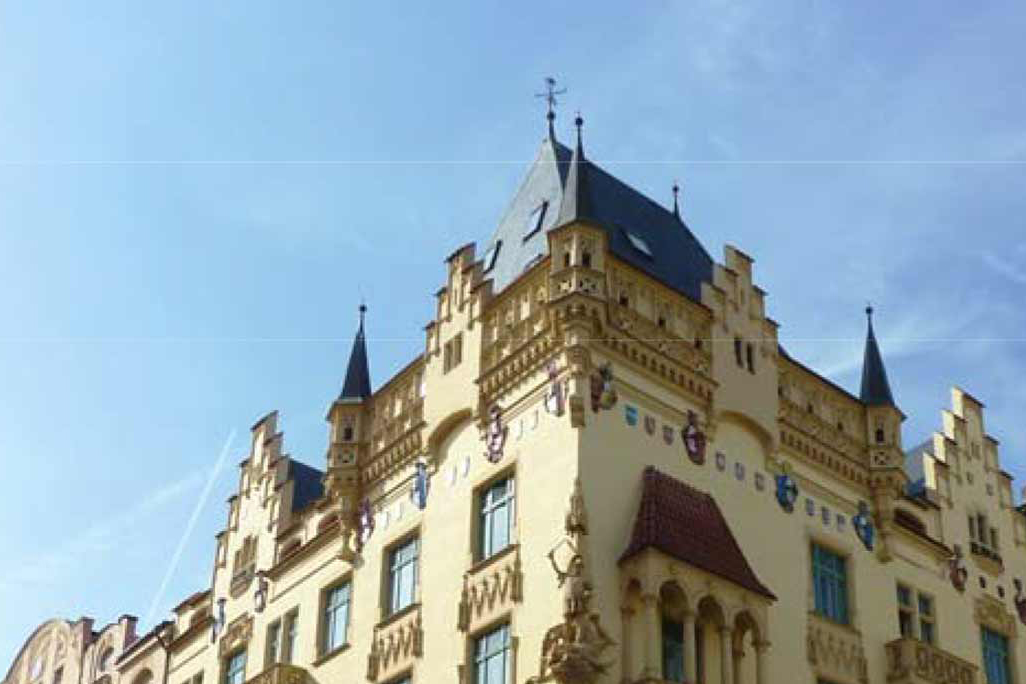
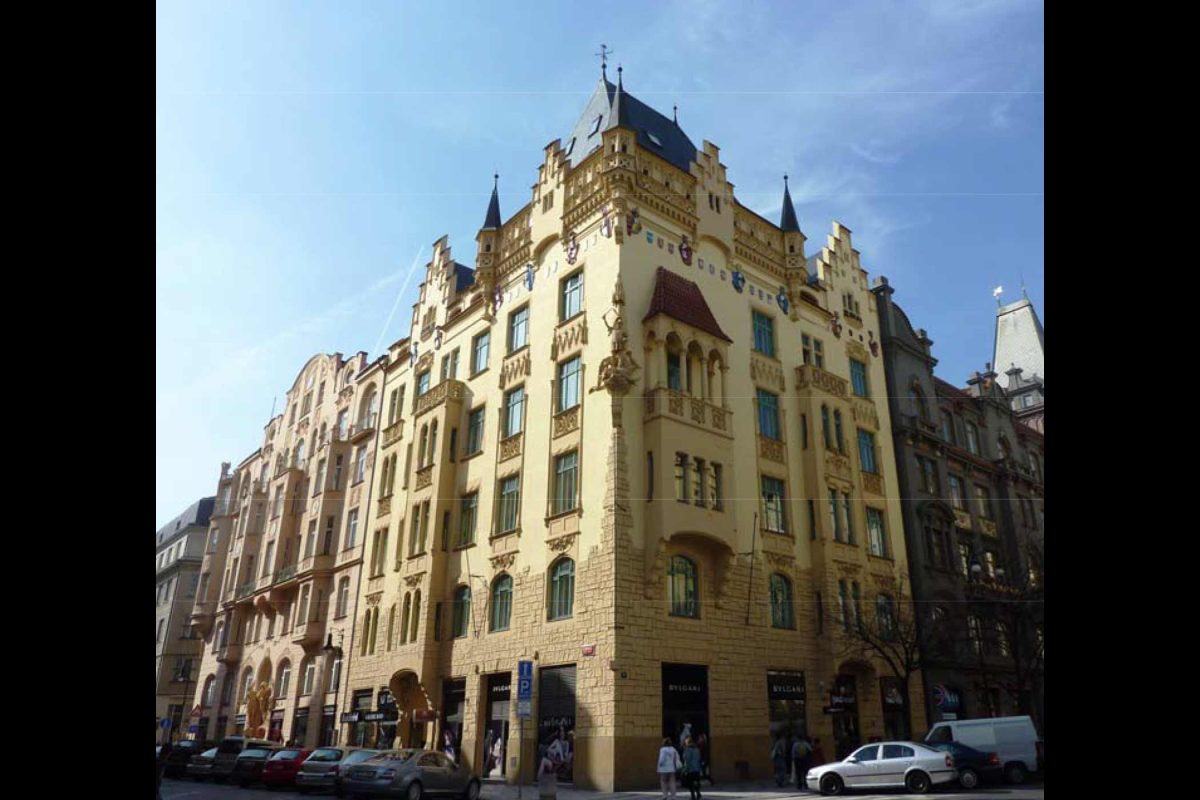
1905
This large corner building features one of Novák’s most elaborate facades. In addition, its decoration is significantly unified by politically charged allusions to the Battle of White Mountain. Most of the stucco decoration therefore relates more or less directly to this theme. The ground floor of the building, which houses retail spaces, features stucco pilaster strips extending up to the height of the first-floor windows. The suprafenestrae above the first-floor windows consist of deep reliefs featuring several heads and a gilded inscription beneath them. The inscription bands alternate between verses from the chorales “Saint Wenceslas, Duke of Bohemia” and “You Who Are God’s Warriors.” These groups thus embody the two branches of Czech piety: Catholic and Utraquist.
The Chalice Relief consists of four heads; in addition, on the far left, we see a right hand firmly clutching a chalice, a reference to the Hussite movement. Next to the chalice is the face of a warrior, partially obscured by a large helmet. The centrally placed head of an elderly man with a bushy beard likely refers directly to Jan Hus. The remaining two heads, shown more in profile, depict villagers—a man and a woman—wearing traditional head coverings. The figures’ richly and modernly rendered hair and beards flow dynamically even into the space of the inscription band. The expressions on all the faces depicted reveal a painful tension, as if tempered by solemnity and resolve.
Beneath this relief is the text of a chorale, divided into the following inscriptions: “You who are God’s,” “and His law,” “ask of God,” “for help and hope.”
The Catholic relief is dominated by the head of St. Wenceslas in a helmet, placed at its center. His face is dignified and distinctly somber; the dark circles under his eyes and the hint of tears heighten its powerful emotional impact. Flanking the saint are the faces of a nun (wearing a stylized veil, part of her religious habit) and a monk (with a tonsure), symbolizing religious life. The nun has her eyes closed in meditation and her head tilted back, which may refer to contemplative orders. The youthful-looking monk is turned toward the saint, to whom he pays homage with his hands clasped tightly together. The last figure depicted is a man wearing a hat; given the overall ideological theme of this group, he is likely a member of the Jesuit Order, as the hat was part of the Jesuit habit. The inscription bands beneath this relief read: “Saint Wenceslas,” “Duke of the Czech Lands,” “Our Prince!”
Above the fourth-floor windows, the decoration continues along a different thematic line. Here we find the golden inscription “1621,” above which ravens, rendered in deep stucco relief, are perched. Running horizontally along the entire upper cornice of the building is a procession of the coats of arms of twenty-one Czech nobles who were executed after the Battle of White Mountain. The coats of arms are rendered in color, and some are further accentuated by decorative drapery and helmets.
The most striking feature of the building, however, is the statue of St. George, located on the corner at the level of the third floor. It is a fully three-dimensional figure, crafted in great detail. Even within the broader context of Novák’s work, as far as facade decoration is concerned, this statue is an absolute rarity. The saint is depicted with his right arm dynamically outstretched, gripping a sword. His gaze follows the vanquished dragon, which lies on its back. The saint’s entire figure is positioned freely within the space of the pedestal, touching the facade only at the tip of the sword and the end of the dragon’s coiled tail. St. George wears a helmet with a luxuriant crest; the scaled armor covering his torso is also rendered in great detail, including cross-shaped decorations on the belt and the spirally twisted hilt of his dagger. The protective plates on the warrior’s legs are also richly decorated with spirals and lion heads; his overall posture appears both dynamic and balanced. The dragon lies on its back beneath the saint’s feet, its mouth open and tongue hanging out. The dragon’s spiraling tail adds elegance to the entire composition and also more strongly connects the sculpture group to the façade, so that this group does not appear as a standalone piece.
MP Rožánek’s house is one of Novák’s most interesting facades, both in terms of concept and the quality of its execution. The goal of the facade’s decorative scheme was to create a sort of multi-layered ode to the Czech lands. There is a strong reference to the Battle of White Mountain and the executed Czech nobles.