

1906–1911
The first decade of Novák’s independent work culminates in what is perhaps his best-known and most acclaimed commission: the decoration of Prague’s Municipal House. Even in light of Novák’s later work, his pieces for the Municipal House can be seen as the pinnacle of the sculptor’s career.
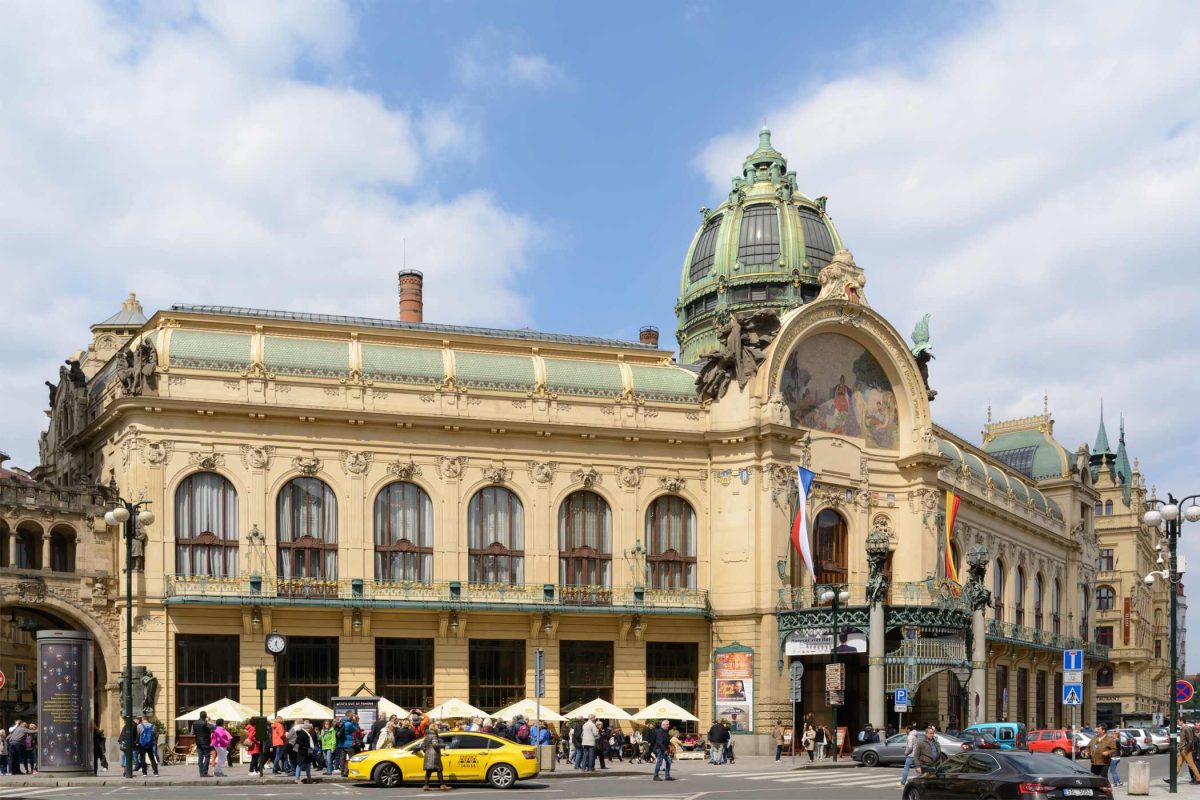
The new Municipal House building was a joint project by architect Antonín Balšánek, a professor at the Czech Technical University, and architect Osvald Polívka, an imperial-royal building councilor in Prague. In the period press, which naturally covered the topic of the Municipal House with great interest and on numerous occasions, we find, among other things, a complete list of all the decorative work carried out on the building. Karel Novák is listed as the creator of the exterior stonework on the main facade; in addition, however, he also contributed to the interior stonework. He was entrusted with the Sladkovský Hall, the Palacký Hall, the Julius Grégr Hall, the Smetana Hall, the dining rooms on the first floor, the ladies’ salons, the pastry shop, the bar, and the folk restaurant. Furthermore, Novák’s name appears in the list of sculptors who contributed to the sculptural decoration of the facade. Novák’s collaborators on this project included the former co-owner of his firm and current professor Josef Pekárek, as well as Ladislav Šaloun, František Rous, Čeněk Vosmík, Antonín Mára, Franta Úprka, Josef Mařatka, and Augustin Zoula.
Novák played a significant role in the interior decoration. His best-known works can be found in the Smetana Hall.
It was precisely the exterior decoration of the Municipal House’s facades—namely, the mascarons above the windows of the main façade and the figures of the Light-Bearers—that brought Novák the most fame and with which he is most often associated to this day. Each of the series of mascarons represents a specific allegory, though the exact names of the individual heads are unknown. We can therefore only speculate as to what each one symbolizes. For example, the mascaron on which an owl with outstretched wings perches above a face contorted in pain is often described as an allegory of philosophy, while the keystone featuring a face veiled by a flight helmet and goggles—and further adorned with a pair of wings—is said to celebrate aviation. Guided by the language of symbols, we can assume that the head with a luxuriant mane, behind which pipes and tambourines are decoratively stacked, refers to music; equally clear is the head of an elderly man with the traditional attributes of Mercury—that is, commerce. Some symbols, however, are quite ambiguous. The older man’s face is accompanied by scrolls of paper with seals, which we can interpret as a celebration of literature, or even law or politics (the seals). The female face, adorned with ornamental ribbons and festoons, is accompanied by what appear to be cornucopias filled with fruit; thus, the abundance of the earth’s harvest is celebrated here, perhaps specifically in praise of fruit growing. Another male face, apparently an allegory of industry and technology, stands out against the backdrop of a gearwheel, positioned almost like a halo.
The allegory of painting is represented by an elderly man with long hair, flanked on either side of his face by large, decorative volutes. Tucked behind these volutes are paintbrushes, as if hidden there. Identifying this mascaron without being able to see it up close must have been very difficult for the average viewer; however, a clue might have been the mascaron’s location on the corner, the upper part of which is adorned with figural sculptures representing allegories of the fine arts. On the other side of the corner is a female mascaron, which, however, lacks any specific clue—only a profusion of flowers resembling poppies. All the mascarons described so far are aligned in a single row above the facade’s windows. Another mascaron, depicting Athena, the patron goddess of the arts, can be found higher up, beneath the attic cornice. All the mascarons are masterfully sculpted and captivate the viewer primarily with their unusual facial expressions. The intricate facial expressions, combined with the imaginative attributes and their arrangement, create a fresh impression and rightly attract well-deserved attention.
When we speak here of the work on the Municipal House as a sign of belonging to the artistic elite of the time, we are setting aside the entire body of criticism directed at the Municipal House, which was already very strong at the time of its construction. It is a well-known fact that the Municipal House was, in fact, already stylistically passé by the time of its completion. Nevertheless, artists whom we rightly consider to be the leading representatives of their era contributed to it. Novák’s place among them therefore carries significant symbolic weight. After all, Novák’s work falls squarely within the tradition of Art Nouveau artists—decorators—and remains essentially untouched by later stylistic developments in sculpture. That is why we see its pinnacle precisely in the works he created for the Municipal House, however retrograde the building itself may be.
Novák also created other stucco decorations on the facade: colored and gilded city coats of arms, relief floral and ornamental motifs, vases, and the like. It is likely that he also created the figures of seated youths above the windows on the side facades, whose facial features and style of execution are in keeping with the style of the mascaron.
The culmination of Novák’s contribution to the decoration of the Municipal House was the sculptures of the Light-Bearers above the main entrance, holding large electric lamps. Full-figure, fully three-dimensional sculptures are rare in the sculptor’s body of work; therefore, the Light-Bearers can be considered a truly exceptional work, not only within the context of the Municipal House’s decoration. The sculptures of the Light-Bearers are arranged in a mirror image, facing each other (or, rather, the main entrance). They are nearly identical, though the way the two figures sit differs slightly; the figure on the left sits with his legs apart, while the one on the right has his legs closer together and crossed at the ankles. Both figures convey an evocative combination of relaxation and strength. The slender male figures, holding a crystalline lamp structure above their heads, are seated on columns whose capitals are shaped like bucrania; the conventional volutes are replaced by bull’s horns. The classical symbolism continues with the motif of Hercules’ lion skin, which the men have tied around their waists; the way it is tied differs slightly between the two statues. A small boy stands on each man’s lap, raising a flaming torch with his hand. The youths’ faces are very delicate, serene, and dignified. Their flowing hair and drapery correspond with the motif of the torch’s flame. The festoons, hanging decoratively along the bull’s heads, depict stylized fruits (resembling rose hips), sharply carved, as if in harmony with the sharp edges of the light-reflecting crystals.
Although the exterior of the Municipal House boasts a whole series of high-quality sculptures, the placement of the light-bearers in the most prominent spot demonstrates just how prominent this commission was. The fact that Novák was entrusted with such an important task is the best proof that his contemporaries rightly ranked him among the leading artists of his time.